 |
hyperledger/iroha
Iroha - A simple, decentralized ledger http://iroha.tech
|


|
|
hyperledger/iroha
Iroha - A simple, decentralized ledger http://iroha.tech
|
|
#include "timeout.hpp"
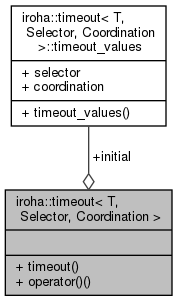
Classes | |
| struct | timeout_observer |
| struct | timeout_values |
Public Types | |
| typedef rxcpp::util::decay_t< T > | source_value_type |
| typedef rxcpp::util::decay_t< Coordination > | coordination_type |
| typedef coordination_type::coordinator_type | coordinator_type |
| typedef rxcpp::util::decay_t< Selector > | select_type |
Public Member Functions | |
| timeout (select_type s, coordination_type coordination) | |
| template<class Subscriber > | |
| auto | operator() (Subscriber dest) const -> decltype(timeout_observer< Subscriber >::make(std::move(dest), initial)) |
Public Attributes | |
| timeout_values | initial |
This class is mostly the same as rxcpp::operators::timeout, the only change is that it accepts a selector lambda which generates a duration based on observable value instead of a fixed duration Return an observable that terminates with timeout_error if a particular timespan has passed without emitting another item from the source observable Timespan is generated with selector from the last received value
| T | value type |
| Selector | the type of the transforming function which returns time interval |
| Coordination | the type of the scheduler |
| typedef rxcpp::util::decay_t<Coordination> iroha::timeout< T, Selector, Coordination >::coordination_type |
| typedef coordination_type::coordinator_type iroha::timeout< T, Selector, Coordination >::coordinator_type |
| typedef rxcpp::util::decay_t<Selector> iroha::timeout< T, Selector, Coordination >::select_type |
| typedef rxcpp::util::decay_t<T> iroha::timeout< T, Selector, Coordination >::source_value_type |
|
inline |
|
inline |

| timeout_values iroha::timeout< T, Selector, Coordination >::initial |
 1.8.13